The following information is extracted from the Independent Market Research Report titled “Independent Assessment of the Educational Publishing Industry focusing on National School Curriculum in Malaysia” prepared by Vital Factor Consulting Sdn Bhd for inclusion in the prospectus of Sasbadi Holdings Berhad dated 7 July 2014.
BACKGROUND AND INTRODUCTION
Sasbadi Holdings Group is primarily a publisher of educational materials based on the Malaysian National School Curriculum focusing on primary and secondary education, which is the focus of this industry assessment
INDUSTRY OVERVIEW AND STRUCTURE
Overview of the Publishing Industry
Generally, the Publishing Industry covers diverse areas as depicted in the figure below:

The focus of this report is on content publishing. In Malaysia, the content publishing industry is mainly focused on print publications in terms of monetary values. As such, statistics for the publications of books and other materials mentioned in this report are mainly for print publishing, unless mentioned otherwise. Similarly, the term publisher is primarily used to refer to print publishing, unless mentioned otherwise.
Structure of the Content Publishing Industry
The Content Publishing Industry in Malaysia is generally segmented as follows:

Educational Publishing refers to the publication of materials designed to teach or to enable the users or consumers to learn and acquire knowledge and skills through these materials. Educational publishing may focus on specific syllabus, curriculum or course work to obtain some specific learning outcome. It also includes supporting materials to facilitate the learning process or add to the users’ knowledge and skill base. Some examples of educational publishing materials include textbooks, revision guides, workbooks, reference books, sample examinations questions and other prescribed learning materials.
Structure of Educational Publishing Industry
In Malaysia, the Educational Publishing Industry is segmented as follows:

Educational Publishing of National School Curriculum materials refer to the publishing of materials based on the national school curriculum as prescribed by the Ministry of Education in Malaysia. These materials include textbooks, workbooks, revision guides and other reference and related materials that follow or are related to the National School Curriculum. With the exception of international, expatriate, correspondence and some special education and religious schools, the national curriculum shall be used by all schools including kindergartens, primary and secondary schools in Malaysia.
Sasbadi Holdings Group is primarily involved in the business of educational publishing focusing on Malaysian National School Curriculum based materials.
Publishing Medium
Generally, publications are stored and distributed through three main media, as follows:

Sasbadi Holdings Group mainly uses print medium, but has a small proportion of its contents available online.
National Education System in Malaysia
The National Education System in Malaysia comprises the following:
- Pre-school education
- Primary education
- Secondary education
- Post-secondary education
- Higher education
| Note: The focus of this report is on primary and secondary education. |
Educational Institutions in Malaysia
In Malaysia, there are three categories of educational institutions:
- Government educational institutions
- Government-aided educational institutions
- Private educational institutions
The types of primary and secondary educational institutions in Malaysia are categorised into two major types as follows:
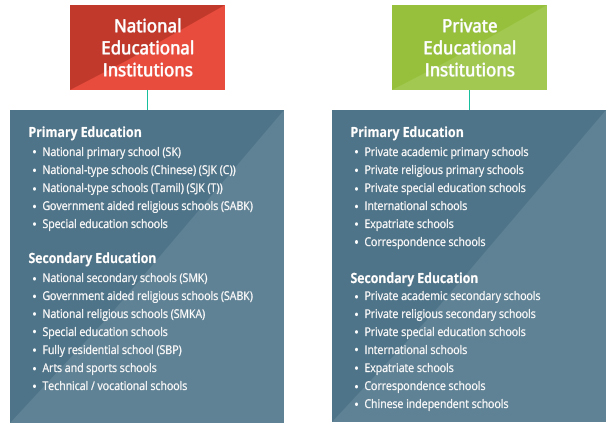
Notes:-
| SK = Sekolah Kebangsaan; |
| SJK (C) = Sekolah Jenis Kebangsaan (Cina); |
| SJK (T) = Sekolah Jenis Kebangsaan (Tamil); |
| SABK = Sekolah Agama Bantuan Kerajaan; |
| SMK = Sekolah Menengah Kebangsaan; |
| SMKA = Sekolah Menengah Kebangsaan Agama; |
| SBP = Sekolah Berasrama Penuh. |
Currently, only primary education is compulsory for all Malaysians.
SUPPLY AND DEMAND CONDITIONS
Number of Book Titles Published in Malaysia
The supply conditions of the industry can be represented by the number of book titles published in Malaysia, which is registered under the Deposit of Library Material Act 1986.
| Number of Book Titles Published in Malaysia | ||||||
|---|---|---|---|---|---|---|
| 2009 | 2010 | 2011 | 2012 | 2013 | AAGR 2009- 2013(%) |
|
| Adult 1 | 7,609 | 7,787 | 9,448 | 9,554 | 9,064 | 4.5 |
| Textbook 2 | 3,969 | 4,218 | 4,638 | 5,550 | 6,241 | 12.0 |
| Children 1 | 4,189 | 3,751 | 3,837 | 4,095 | 4,682 | 2.8 |
| TOTAL | 15,767 | 15,756 | 17,923 | 19,199 | 19,987 | 6.1 |
Notes:-
| AAGR = Average annual growth rate; | |
| (1) | Includes educational and non-educational books; |
| (2) | In addition to textbooks, this category also includes other student materials including workbooks, revision guides and reference books. |
Source: National Library of Malaysia
Gross Output Value of Publishing Services
The supply and demand conditions of the publishing industry (including educational and non-educational materials) can be assessed by the gross output value of publishing activities, as follows:
| Gross Output Value of Publishing Services in Malaysia | |||||
|---|---|---|---|---|---|
| 2009 | 2010 | 2011 | AAGR 2009-2011(%) |
||
| Publishing Services | 741.7 | 1,018.0 | 1,184.9 | 26.4 | |
| Note: Includes educational and non-educational publishing. All units in RM million except percentages. |
Source: Department of Statistics
Import and Export Value of Printed Matter
The import and export values of printed matter can also be used as a proxy to assess the supply and demand conditions for the Educational Publishing Industry.
| Import and Export Value of Selected Printed Matter (Malaysia) | |||||||
|---|---|---|---|---|---|---|---|
| 2009 | 2010 | 2011 | 2012 | 2013 | AAGR 2009- 2013(%) |
||
| Printed Books, Brochures, Leaflets and Similar Printed Matter 1 | |||||||
| Import Value | 524 | 483 | 493 | 536 | 487 | -1.8 | |
| Export Value | 559 | 528 | 511 | 502 | 523 | -1.7 | |
| Children's Picture, Drawing or Colouring Books | |||||||
| Import Value | 11 | 16 | 11 | 14 | 23 | 21.9 | |
| Export Value | 2 | 3 | 6 | 3 | 5 | 26.1 | |
Notes:-
| Includes educational and non-educational publishing. All units in RM million except percentages. | |
| (1) | Whether or not in single sheets. |
Source: Department of Statistics
Household Expenditure
The average monthly household expenditure on various publication materials will provide some indication of their respective demand.
| Average Monthly Household Expenditure (Malaysia) | ||||
|---|---|---|---|---|
| 2004/05 | 2009/10 | AAGR 2004/05- 2009/10(%) |
||
| Newspapers 1 | 8.55 | 9.14 | 1.3 | |
| Books 2 | 2.78 | 1.71 | -9.3 | |
| Magazines and Periodicals 3 | 2.02 | 1.53 | -5.4 | |
Notes:-
| Includes educational and non-educational materials. All units in RM except percentages; | |
| (1) | Includes daily and weekly newspapers in any language; |
| (2) | Includes text books, examination reference books, other school books, story books / novels and others such as dictionaries, self-development books and computer books; |
| (3) | Includes local and imported magazines and periodicals and others such as comics and school magazines. |
Source: Department of Statistics
Household Use of Internet on Education
Based on the Household Use of Internet surveys conducted by the Malaysian Communications and Multimedia Commission (MCMC):
| Household Use of Internet | ||||
|---|---|---|---|---|
| 2008 | 2009 | 2011 | ||
| Education (%) | 64.5 | 46.0 | 63.5 | |
Source: Malaysian Communications and Multimedia Commission
A significant proportion of households with internet access uses it for educational purposes. Greater use of the internet for education would indicate higher demand for online publication materials.
SUPPLY DEPENDENCIES
The supply of paper is one of the main raw materials for the print publishing industry in general. As such, the supply dependencies of print publications, including those for educational materials, can be assessed by the following statistics:
- Production quantity of paper
- Import quantity of paper
- Sales value of printing
Production Quantity of Paper
In 2010, there were 175 establishments involved in the manufacture of pulp, papers and paperboard in Malaysia.
The production quantity of paper used in print publications is as follows:
| Production Quantity of Paper in Malaysia | |||||||
|---|---|---|---|---|---|---|---|
| 2009 | 2010 | 2011 | 2012 | 2013 | AAGR 2009- 2013(%) |
||
| Uncoated Woodfree Paper | 154 | 161 | 135 | 157 | 184 | 4.5 | |
| Note: All units in thousand tonnes except percentages. |
Source: Department of Statistics
Import Quantity of Paper
Apart from local sources, publishers may also purchase paper through overseas sources.
The import quantity of paper used in print publications is as follows:
| Import Quantity of Paper (Malaysia) | |||||||
|---|---|---|---|---|---|---|---|
| 2009 | 2010 | 2011 | 2012 | 2013 | AAGR 2009- 2013(%) |
||
| Newsprint | 143 | 184 | 92 | 161 | 187 | 6.9 | |
| Uncoated Printing and Writing Paper | 88 | 102 | 75 | 127 | 111 | 5.9 | |
| Note: All units in thousand tonnes except percentages. |
Source: Department of Statistics
Sales Value of Printing
The sales value of printing in Malaysia is shown as follows:
| Sales value of Printing in Malaysia | |||||||
|---|---|---|---|---|---|---|---|
| 2009 | 2010 | 2011 | 2012 | 2013 | AAGR 2009- 2013(%) |
||
| Printing | 522 | 638 | 809 | 1,009 | 1,097 | 20.4 | |
| Note: All units in RM million except percentages. |
Source: Department of Statistics
DEMAND DEPENDENCIES
As the demand for educational materials depend on end-users and consumers, the following factors will have an impact on the overall Educational Publishing Industry:
- Per capita income
- Population growth
- Enrolment in schools
- Number of schools
- Number of teachers
- Educational indicators
In addition, the demand for online educational materials is dependent on the number of online users. As such, the demand dependencies can be assessed by the following statistics:
- Number of broadband subscriptions
- Broadband penetration rate
Number of Broadband Subscriptions
Growth in number of broadband subscriptions would provide a bigger pool of potential users of online educational materials.
| Number of Boardband Subscriptions in Malaysia | |||||||
|---|---|---|---|---|---|---|---|
| 2009 | 2010 | 2011 | 2012 | 2013 | AAGR 2009- 2013(%) |
||
| Household | 1,972 | 3,672 | 4,270 | 4,338 | 4,558 | 23.3 | |
| Non-Household | 649 | 1,051 | 1,417 | 1,777 | 1,815 | 29.3 | |
| TOTAL | 2,620 | 4,722 | 5,687 | 6,115 | 6,373 | 24.9 | |
| Note: All units in thousands except percentages; Total does not add-up due to rounding. |
Source: Malaysian Communications and Multimedia Commission
Broadband Penetration Rate
A higher broadband penetration rate would provide increased opportunities for providers of online publishing services.
| Broadband Penetration Rate in Malaysia | ||||||
|---|---|---|---|---|---|---|
| 2009 | 2010 | 2011 | 2012 | 2013 | ||
| Population (per 100 inhabitants) | 9.2 | 16.6 | 19.4 | 21.7 | 22.6 | |
| Household (per 100 households) | 31.7 | 55.6 | 62.3 | 66.0 | 67.1 | |
Source: Malaysian Communications and Multimedia Commission
COMPETITIVE ANALYSIS
Nature of Competition in the Industry
Competition within the Education Publishing Industry focusing on National School Curriculum can be segmented into two levels, namely:
- government authorised publishing of textbooks and supporting educational materials;
- general educational materials to supplement government authorised textbooks and supporting educational materials.
Factors of Competition
As with most free enterprise environment, competition within the Educational Publishing Industry focusing on the National Curriculum is based on a number of factors, including:
- Brand name;
- Track record and market reputation;
- Distribution network; and
- Economies of scale.
BARRIERS TO ENTRY
- Capital and Set-up Costs
The barriers to entry for new entrants as an educational publisher based on capital requirements (excluding land and building) are relatively low.
- Availability of Retail Shelf Space
Publications of new entrants in the Educational Publishing Industry may not have immediate access to sought-after shelf space especially from larger bookstore chains until the products are more established in the market.
- Experienced and Sought-After Authors
A new entrant in the industry without an existing pool of experienced and sought-after authors is less likely to make an impact on the market. For instance, teachers who are well versed with the requirements of the national curriculum are suitable candidates to be authors of educational materials. As such, an established network of teachers or other such potential authors is necessary for a new publisher to have access to good manuscripts that will lead to successful or relevant publications.
THREAT OF SUBSTITUTES
- Digitalisation of Contents
The educational market in Malaysia largely relies on printed educational materials. Digitalisation of content would be a direct substitute to printed materials. As such, if there was a strong shift towards the use of digital content, then publishers that are slow in making the change over will be negatively affected.
- Online and Electronic Delivery Format
The digitalisation of content would give rise to the threat of substitute of delivery of content. The online delivery method would directly be a threat of substitute to the print publication industry that relies on distributing books and other printed materials to retailers and ultimately end-users.
INDUSTRY PROSPECTS AND OUTLOOK
The outlook of the Educational Publishing Industry is dependent on the following factors:
- Performance of the education sector focusing on primary and secondary schools
- Government initiatives
- Population, income and expenditure
- Economic conditions
DRIVERS OF GROWTH
Some of the drivers of growth for the Educational Publishing Industry are as follows:
- Improving education indicators
- Socio-economic growth
- Government initiatives
- Growing reading culture
- Online educational initiatives
MARKET SEGMENTATION, SIZE AND SHARE
Market Operator Segmentation
The Educational Publishing Industry in Malaysia comprises two tiers of private publishers based on revenue size. Based on available information as at April 2014, details of the two tiers of publishers are as follows:
- 1st tier: Comprises the top three publishers where each publisher’s revenue exceeds RM40 million per year. The top three publishers in alphabetical order are Oxford Fajar Sdn Bhd, Pelangi Publishing Group Bhd and Sasbadi Holdings Group.
Each of the top three publishers had market shares that were relatively close to each other. No one publisher had more than 10% share of the printed educational materials market in Malaysia. - 2nd tier: Comprises approximately 200 publishers where each publisher’s revenue is less than RM40 million per year.
| Note: Revenue used for segmenting operators into two tiers is based on their total revenue, which includes publishing of educational materials, and may also include other related and non-related activities. Publishers above refer to those who are involved in the business of publishing on a regular basis. |
Source: Secondary Market Research undertaken by Vital Factor Consulting Sdn Bhd
Market Size
- In 2013, the market size of the publishing of books, brochures and other publications (including educational and non-educational materials) in Malaysia was approximately RM1.0 billion (Source: Department of Statistics and computed by Vital Factor Consulting Sdn Bhd).
- In 2013, the market size for printed educational materials in Malaysia was approximately RM750 million based on apparent consumption (Source: Department of Statistics and computed by Vital Factor Consulting Sdn Bhd).
Market Share
In 2013, Sasbadi Holdings Group had a market share of 6% of the publishing of books, brochures and other publications (including educational and non-educational materials) in Malaysia based on the Group’s revenue from print publications (Source: Vital Factor Consulting Sdn Bhd).
In 2013, Sasbadi Holdings Group had a market share of 9% of printed educational materials in Malaysia based on the Group’s revenue from print publications (Source: Vital Factor Consulting Sdn Bhd).
* Please read this section in conjunction with Section 7 from page 135 to page 175 of Sasbadi Holdings Berhad's Prospectus dated 7 July 2014.